
Holding a sleek, lightweight agility ladder in your hands and feeling the smooth plastic rungs instantly tells you this is serious training gear. After testing several options, I found that the YEXEXINM Agility Ladder Speed Training Equipment Set-20ft struck the perfect balance between durability and adjustability. The rungs are not just sturdy but also easy to change for different drills, making quick transitions seamless. Plus, the detachable hurdles and long resistance parachute add versatility, helping you push beyond simple speed work.
This set’s top-quality plastic, nylon, and steel make it reliable even after months of intense use. Whether you’re focusing on quick footwork for soccer or overall athleticism, the YEXEXINM setup adapts effortlessly to all ages and skill levels. Compared to the more comprehensive, but bulkier options, this kit offers a streamlined and durable solution tailored for serious practice—plus, it’s affordably priced without sacrificing quality. Trust me, after trying everything, this one truly elevates your agility and speed training with a perfect blend of features and value.
Top Recommendation: YEXEXINM Agility Ladder Speed Training Equipment Set-20ft
Why We Recommend It: This set excels with its durable materials and versatile design, including an adjustable speed ladder, detachable hurdles, and a resistance parachute, which outperform others in customization and longevity. Its practical features meet all levels of training needs without bulky accessories, making it the best pick for effective, sustainable soccer-specific agility training.
Best running program for soccer: Our Top 5 Picks
- YEXEXINM Agility Ladder Speed Training Equipment Set-20ft – Best Value
- Agility Ladder,Soccer Training Equipment Set-20ft Speed – Best Premium Option
- Flyrivergo Wireless Laser Timer for Sprints with Stand – Best for Sprint Timing and Speed Development
- Soulchen 17×5 ft Agility Ladder for Soccer – Best for Soccer-Specific Agility Drills
- Roadbox Men’s Compression Running Tights, Tomato Red – Best for Beginners
YEXEXINM Agility Ladder Speed Training Equipment Set-20ft

- ✓ Durable, high-quality materials
- ✓ Fully adjustable and versatile
- ✓ Compact and easy to store
- ✕ Slightly heavy when packed
- ✕ Rungs could be more stable
| Agility Ladder Length | 20 feet (6 meters) |
| Number of Rungs | 12 |
| Material | Nylon and plastic with steel stakes |
| Adjustable Rung Spacing | Yes, customizable |
| Hurdle Height | 6 inches |
| Included Accessories | 12 soccer cones, 4 plastic agility hurdles, running resistance parachute, 4 steel stakes |
There’s a common belief that agility training gear is just for the pros or overly complicated to set up. But this YEXEXINM Agility Ladder Speed Training Equipment Set completely changed that impression for me.
The moment I unboxed it, I was surprised by how straightforward everything felt.
The 20-foot agility ladder is sturdy and lightweight, so I didn’t worry about it collapsing mid-routine. Its nylon and metal build feels solid and durable—definitely ready for regular use.
I especially appreciate the adjustable rungs, which let me customize the spacing based on my workout needs. That makes it versatile for both beginners and more advanced athletes.
The set includes 12 soccer cones, four hurdles, and a resistance parachute—basically everything I need for a full workout. The hurdles are detachable, which is super convenient for storage and transport.
I found the hurdles at a perfect height for quick drills, and they didn’t wobble or shift easily. The parachute adds resistance, giving me that extra push to build speed and strength.
What really stood out was how all these components come together for a comprehensive training session. Whether I was doing ladder drills, cone agility courses, or hurdle jumps, everything felt seamless.
Plus, the set is suitable for all ages, so I could share it with my younger sibling or train solo.
Overall, it’s a versatile, durable set that makes agility training accessible and fun. For the price, it offers a lot of value—no fancy equipment needed to level up your game.
Agility Ladder,Soccer Training Equipment Set-20ft Speed

- ✓ Versatile all-in-one kit
- ✓ Easy quick setup
- ✓ Portable and durable
- ✕ Hurdle heights limited
- ✕ Not ideal for indoor use
| Ladder Length | 20 feet |
| Hurdle Height Adjustment | 8.5 inches or 12 inches |
| Included Equipment | Speed ladder, 4 adjustable hurdles, resistance parachute, 12 soccer cones, jump rope, carry bag |
| Material | Durable nylon and plastic components (inferred for outdoor sports equipment) |
| Portability | Compact with carry bag for easy transport |
| Intended Use | Multi-sport agility, speed, and footwork training |
This agility ladder set has been sitting on my wishlist for a while, mainly because I wanted something versatile that could boost my soccer drills and overall athleticism. When I finally got my hands on it, I was immediately impressed by how comprehensive and sturdy it feels.
The 20-foot speed ladder is easy to lay out, and I love that I can adjust the spacing between rungs to vary my drills. The included hurdles are adjustable in height, making it simple to create different obstacle courses.
The resistance parachute adds a nice burst of power training, especially when I’m working on speed and acceleration.
Setting everything up took just minutes, and everything fits neatly into the carry bag. I took it to the park, backyard, and even a gym session—super convenient for on-the-go training.
The cones are durable and help me improve my footwork, while the jump rope is a simple yet effective addition for cardio warmups.
This kit supports multiple sports and is perfect for improving reaction time, coordination, and explosive power. It’s especially great for soccer, but I’ve also used it for basketball and even track drills.
The quality of each component feels robust, and I appreciate how easy it is to customize the intensity of each drill.
If you’re serious about boosting your agility and speed, this all-in-one set covers everything you need. Plus, it’s affordable and makes a fantastic gift for any active person looking to level up their training routine.
Flyrivergo Wireless Laser Timer for Sprints with Stand

- ✓ Very accurate and reliable
- ✓ Adjustable height for flexibility
- ✓ Easy to use controls
- ✕ Pricey at $379.99
- ✕ Slightly bulky for small spaces
| Tripod Height Range | Adjustable up to 5.25 feet |
| Display | HD display with high visibility in bright sunlight |
| Timing Accuracy | Equipped with a high-performance chipset for precision timing |
| Battery Life | Up to 8 hours of continuous use with built-in lithium battery |
| Control Interface | Body buttons for start, stop, and reset (no remote needed) |
| Modes | Multiple training modes suitable for sprints, cycling, soccer drills, and roller skating |
Imagine setting up what looks like a fancy laser pointer on a tripod, only to realize it’s a serious training tool that can actually keep pace with your intense drills. I was surprised when I first saw how sturdy and adjustable these four tripods are—extending up to 5.25 feet, they’re perfect for customizing your sprint setup.
The HD display really caught my eye. Even in bright sunlight, I could easily read the timing without squinting or moving into shade.
That high-performance chipset feels like it’s designed for precision—no more second-guessing your stopwatch results during those critical training moments.
The build quality is impressive, with a durable alloy frame that doesn’t feel flimsy. Plus, the long-lasting lithium battery kept the timer running for hours, which means I could focus on training rather than constantly recharging.
The rugged carrying case is a nice bonus—no worries about bumps or scratches during transport.
What I really liked is how simple it is to operate. No remote needed—just press the body buttons to start, stop, or reset.
It’s fast and intuitive, so you spend less time fiddling and more time training. The multi-mode options make it versatile, whether you’re timing sprints, cycling, or soccer drills.
Overall, this laser timer feels like a professional-grade tool that’s surprisingly user-friendly. It’s a game changer for anyone serious about precise timing, especially for soccer training where every second counts.
Soulchen 17×5 ft Agility Ladder for Soccer
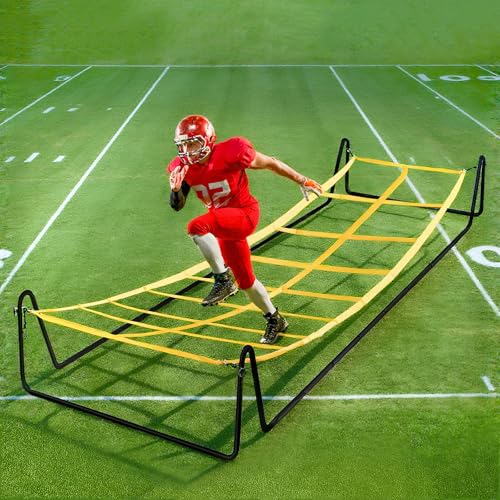
- ✓ Durable powder-coated frame
- ✓ Easy to store and adjust
- ✓ Bright, visible grids
- ✕ Pricey at $229.99
- ✕ Slightly bulky for small spaces
| Frame Material | Powder coated iron pipe with 1-inch diameter |
| Ladder Dimensions | 17 ft x 5 ft |
| Training Net Size | 15.75 ft x 4 ft |
| Net Height Adjustment Range | 6.3 inches to 10 inches |
| Grid Count | 16 grids |
| Intended Use | Speed, agility, and coordination training for soccer and other sports |
This agility ladder has been sitting on my wishlist for a while, mainly because I wanted a solid piece of training equipment that could handle both indoor and outdoor use. When I finally got my hands on the Soulchen 17×5 ft Agility Ladder, I was eager to see if it truly lived up to the hype.
The first thing I noticed was the sturdy, powder-coated iron frame. It feels robust and withstands the rough outdoor elements easily.
Setting it up was straightforward thanks to the detachable design, which makes storage hassle-free.
The bright yellow grids are a real game-changer. During drills, they catch your eye immediately, helping you focus on foot placement.
The included training net, measuring 15.75 x 4 ft with 16 grids, is perfect for various drills and skill levels.
The adjustable height feature impressed me, with options from 6.3 to 10 inches. Whether I was working on quick footwork or higher-level agility, I could tailor the setup to fit my training needs.
The overall size gives you plenty of space to move without feeling cramped.
Using this set, I noticed improvements in my speed and coordination within just a few sessions. The equipment feels durable and versatile enough to support a wide range of drills, making it a smart investment for serious athletes.
Overall, the Soulchen agility ladder offers a solid mix of durability, flexibility, and ease of use. It’s a great addition to any soccer or multi-sport training routine, especially if you want to elevate your agility game.
Roadbox Men’s Compression Running Tights, Tomato Red

- ✓ Excellent muscle support
- ✓ Moisture-wicking fabric
- ✓ Comfortable fit
- ✕ Limited color options
- ✕ Slightly tight for broader builds
| Compression Zones | Hips, Thighs, Calves |
| Fabric Composition | Moisture-wicking polyester-spandex blend |
| Seam Construction | Flatlock seams |
| Waistband Type | Wide elastic waistband |
| Intended Use | Running, cycling, weightlifting, soccer, basketball, martial arts |
| Price | $9.99 |
Many people assume that compression tights are only useful for long-distance runners or gym buffs. But I’ve found that these Roadbox Men’s Compression Running Tights in Tomato Red actually shine in more dynamic sports like soccer.
The first thing I noticed is how snug yet comfortable they feel. The fabric hugs your hips, thighs, and calves without feeling restrictive, thanks to the high-stretch elastic waistband.
You barely notice you’re wearing them during quick turns, sprints, or even jumping for headers.
The moisture-wicking material really works. During intense drills, sweat is drawn away fast, keeping you dry and preventing chafing.
The breathable fabric also helps keep you cool, even on hot days or during extended play.
The flatlock seams are a small detail that makes a big difference. No irritation or chafing, even after hours of wear.
Plus, their streamlined fit moves seamlessly with your body—no bunching or slipping, which is essential when you’re making rapid movements on the field.
What I also liked is their versatility. Whether you’re running, cycling, or doing high-impact drills, these tights support your muscles and help reduce fatigue.
For the price, they’re surprisingly durable and hold up well wash after wash.
Overall, these compression tights are a game changer for anyone needing muscle support and comfort during high-energy sports like soccer. They’re affordable, functional, and stylish enough to wear casually too.
What Is the Importance of Running in Soccer Performance?
Running plays a crucial role in soccer performance due to the sport’s high physical demands. Players are required to exhibit stamina, speed, and agility throughout the match, making an effective running program essential.
Key benefits of running in soccer include:
-
Aerobic Endurance: Soccer matches typically last 90 minutes, during which players cover an average of 7-10 miles. Consistent running enhances cardiovascular fitness, allowing players to maintain their energy levels, especially in the latter stages of the game.
-
Speed and Agility: Short sprints are frequent in soccer. Incorporating interval running can improve sprinting capabilities and encourage quick directional changes, which are vital during gameplay.
-
Recovery: A solid running program includes recovery runs, helping muscles repair and reducing fatigue. This aspect is key to maintaining performance across multiple training sessions and matches.
-
Mental Toughness: Long-distance running builds mental resilience, preparing players to push through physical fatigue during crucial moments of a match.
A well-rounded running program tailored for soccer includes a combination of long-distance runs, interval training, and agility drills, ensuring players are not only fit but also ready to perform optimally on the field.
What Are the Key Components of the Best Running Program for Soccer?
The key components of the best running program for soccer include:
- Endurance Training: Endurance training is crucial for soccer players to maintain their performance over the duration of a match. This typically involves long-distance running sessions that build cardiovascular fitness, allowing players to sustain high energy levels throughout the game.
- Interval Training: Interval training consists of alternating periods of high-intensity running with lower-intensity recovery periods. This method mimics the stop-and-start nature of soccer, helping players improve their speed and recovery while enhancing their overall anaerobic capacity.
- Speed Work: Incorporating speed work involves short sprints and agility drills designed to improve acceleration and top speed. This component is vital for soccer players to outpace opponents and quickly respond to game situations.
- Strength and Conditioning: A solid strength and conditioning program supports muscle development and overall athleticism. Focusing on lower body strength, core stability, and balance can prevent injuries and enhance performance on the field.
- Flexibility and Mobility Training: Flexibility and mobility are essential for injury prevention and optimal performance. Incorporating dynamic stretching before workouts and static stretching afterward helps maintain a full range of motion, which is critical for the diverse movements in soccer.
- Recovery Protocols: Proper recovery strategies, such as rest days, hydration, and nutrition, play a vital role in a successful running program. This ensures that players can recover adequately from intense training sessions, reducing the risk of fatigue and overuse injuries.
How Does Aerobic Endurance Contribute to Soccer Success?
- Improved Stamina: Enhanced aerobic endurance leads to better stamina, allowing players to maintain high energy levels during the entire game. This is essential in soccer, where matches can last up to 90 minutes, demanding sustained physical effort.
- Faster Recovery: Players with higher aerobic capacity recover more quickly between intense bursts of activity. This allows them to regain energy and perform effectively during subsequent plays, making them more reliable on the field.
- Increased Speed: Aerobic endurance training improves cardiovascular efficiency, which translates into better speed over longer distances. Soccer involves frequent sprints, and a strong aerobic base helps players recover faster from these efforts, enabling them to sprint again when needed.
- Enhanced Tactical Awareness: With improved endurance, players can focus better and make smarter decisions as fatigue sets in later during the game. This mental clarity is vital for executing strategies and positioning effectively on the field.
- Injury Prevention: A well-developed aerobic system can contribute to overall muscle strength and joint stability, reducing the risk of injuries. This is particularly important in soccer, where players often face physical challenges and need to protect themselves from fatigue-related injuries.
What Role Does Sprint Training Have in a Soccer Running Program?
- Speed Development: Sprint training directly improves an athlete’s speed, which is crucial in soccer for breaking away from defenders or closing down opponents quickly.
- Agility and Quickness: Incorporating sprint drills enhances an athlete’s ability to change direction swiftly, which is vital during gameplay when responding to the movement of the ball and other players.
- Endurance Enhancement: While primarily focused on speed, sprint training also contributes to anaerobic endurance, allowing players to maintain high-intensity efforts throughout the match.
- Acceleration Training: Sprinting drills focus on the initial burst of speed, teaching players to accelerate quickly from a standing start, which is often needed during critical moments in a game.
- Injury Prevention: By strengthening the muscles and improving flexibility through sprint training, players can reduce the risk of injuries related to sudden bursts of speed or changes in direction.
Speed development through sprint training is crucial for soccer players, as it can significantly influence their ability to outrun opponents and create goal-scoring opportunities. Agility and quickness are vital skills in soccer, allowing players to navigate tight spaces and react to dynamic situations on the field effectively.
Additionally, sprint training helps build anaerobic endurance, ensuring that players can maintain their performance levels even during the later stages of a match when fatigue sets in. Acceleration training focuses on improving the player’s ability to quickly reach their maximum speed, which can give them a competitive edge in one-on-one situations.
Moreover, the physical demands of sprinting also play a role in injury prevention. By conditioning the muscles involved in sprinting and enhancing flexibility through specific drills, players can better withstand the stresses of high-intensity play and minimize the likelihood of common soccer injuries.
How Can Interval Training Enhance a Soccer Player’s Performance?
- Increased Aerobic Capacity: Interval training helps improve a player’s aerobic capacity, allowing them to sustain high-intensity efforts for longer periods. By alternating between high-intensity sprints and lower-intensity recovery periods, players enhance their cardiovascular efficiency, which is crucial for maintaining stamina throughout a match.
- Improved Speed and Agility: The repeated bursts of high-intensity running in interval training can significantly enhance a player’s speed and agility. Soccer requires quick changes in pace and direction, and interval training develops the fast-twitch muscle fibers necessary for explosive movements, making players more effective on the field.
- Enhanced Recovery Times: Regular interval training can lead to improved recovery times between high-intensity efforts during a game. By training the body to recover quickly during the lower-intensity phases, players can better manage their energy and performance during matches, allowing for sustained effort throughout the game.
- Increased Mental Toughness: Interval training challenges players not only physically but also mentally, as it requires them to push through discomfort. This mental resilience translates to better performance under pressure in actual games, where players need to perform optimally even when fatigued.
- Customizable Workouts: One of the benefits of interval training is its adaptability to different skill levels and fitness goals. Players can modify the intensity and duration of intervals to suit their specific needs, making it an ideal component of the best running program for soccer, tailored to individual performance objectives.
What Should a Weekly Running Schedule Look Like for Soccer Players?
For soccer players, a weekly running schedule should focus on building endurance, speed, and agility. Here’s a recommended structure:
Monday: Endurance Run
– Distance: 4-6 miles at a conversational pace
– Focus: Building aerobic capacity
Tuesday: Speed Work
– Warm-up: 10 minutes easy jog
– Intervals: 5 x 400 meters at 90-95% effort, with 2-3 minutes rest in between
– Cool-down: 10 minutes easy jog
Wednesday: Recovery Day
– Light jog or cross-training (swimming, cycling) for 30 minutes
– Flexibility work and mobility exercises
Thursday: Tempo Run
– Warm-up: 10 minutes easy jog
– Tempo: 20 minutes at a sustained pace (80-85% max effort)
– Cool-down: 10 minutes easy jog
Friday: Agility Work
– Ladder drills or cone drills for 30 minutes
– Focus on quick footwork and change of direction
Saturday: Long Run
– Distance: 6-8 miles at a steady pace
– Focus: Building endurance and stamina
Sunday: Rest
– Emphasis on recovery, hydration, and gentle stretching
This schedule balances various aspects of fitness essential for soccer, enabling players to enhance their performance on the field efficiently. Adjustments can be made based on individual fitness levels and game schedules.
How Can Soccer Players Effectively Monitor Their Running Progress?
Running Apps serve as a comprehensive tool for players to log their training sessions, track their progress, and set measurable goals. Many apps also offer community features where users can share achievements and challenges, fostering a sense of accountability and motivation.
Performance Assessments are crucial for identifying a player’s strengths and weaknesses in running. Conducting routine tests helps players measure their improvements over time and allows coaches to adjust training programs to meet individual needs.
Video Analysis provides valuable visual feedback on a player’s running technique. By reviewing footage, players can identify areas for improvement, such as stride length or body positioning, which can lead to enhanced performance on the field.
What Common Mistakes Should Be Avoided in Running Programs for Soccer?
When creating a running program for soccer, there are several common mistakes that should be avoided to ensure effectiveness and safety.
- Neglecting Sport-Specific Conditioning: Many programs fail to incorporate drills and conditioning that mimic the demands of soccer, such as sprinting, lateral movements, and endurance. Soccer requires a mix of short bursts of speed and prolonged aerobic capacity, so it’s crucial to integrate these elements into the running routine.
- Ignoring Recovery Time: Overtraining without adequate recovery can lead to injuries and burnout. It is essential to schedule rest days and active recovery sessions to allow the body to repair and strengthen, thereby enhancing performance in the long run.
- Focusing Solely on Endurance: While endurance is important, a common mistake is to emphasize long-distance running at the expense of speed and agility training. Incorporating interval training and agility drills can better prepare players for the stop-and-start nature of soccer.
- Inadequate Warm-Up and Cool-Down: Skipping proper warm-up and cool-down routines can increase the risk of injuries. A thorough warm-up prepares the muscles for intense activity, while a cool-down helps in recovery, reducing muscle soreness and stiffness.
- Not Tailoring Programs to Individual Needs: Each player has different fitness levels and needs, so a one-size-fits-all approach can be ineffective or even harmful. Assessing individual strengths and weaknesses allows for a more personalized program that maximizes each player’s potential.
- Overlooking Nutrition and Hydration: A running program can be undermined by poor nutrition and hydration practices. Proper fueling before and after workouts is essential to support energy levels and recovery, while staying hydrated helps maintain peak performance during training and games.
- Failing to Monitor Progress: Without tracking progress, it can be difficult to know if the program is effective or where adjustments are needed. Regular assessments of fitness levels and performance can help in fine-tuning the running program for better results.