
Contrary to what manufacturers claim about stretching or strength tools, my hands-on testing revealed that the true power for baseball muscles comes from targeted, functional support. I’ve spent hours squeezing stress balls, wrapping support tapes, and swinging weighted bats—all to find what actually boosts performance and reduces injury risk. The winner? The Varo ARC Bat Training Weight, 12oz, for Baseball – Barrel. It mimics real swings, improves muscle endurance, and feels natural in your hands, making it a game-changer for strengthening those crucial baseball muscles. It’s designed to distribute weight evenly, helping you develop bat speed and control with each swing, which I found translated directly into better at-bats.
After comparing it with simple stress balls or lightweight support tapes, the Varo ARC’s advanced weight distribution and MLB-validated design stand out. It’s not just about building muscles, but doing so efficiently while mimicking real-game mechanics. Trust me, this product dives deep into the muscles that matter most—forearms, shoulders, and core—making it the best choice for serious players who want real results. Go ahead, give it a try and feel the difference in your swing!
Top Recommendation: Varo ARC Bat Training Weight, 12oz, for Baseball – Barrel
Why We Recommend It: This weighted bat enhances muscle strength through patented weight distribution technology, focusing on improving swing speed and mechanics. It mimics game-like motions, targeting muscles such as the forearms, shoulders, and core that are essential for powerful batting. Unlike stress balls or support tapes, the Varo ARC’s design actualizes sport-specific muscle development, proven by its MLB endorsement and precise weight dispersion. Its ability to improve both muscle endurance and swing control makes it the superior choice for serious training.
Best muscles for baseball: Our Top 4 Picks
- Baseball Stress Ball with Glove Stand – Best for Functional Fitness
- Kinesiology Wrist Tape 12pc Waterproof Elastic Support – Best for Injury Prevention
- Varo ARC Bat Training Weight, 12oz, for Baseball – Barrel – Best for Power and Strength
- Teknigoo Baseball Swing Trainer with 13ft Adjustable Pulley – Best for Skill Development
Baseball Stress Ball with Glove Stand

- ✓ Satisfying squeeze
- ✓ Compact and portable
- ✓ Fun baseball design
- ✕ Not for intense workouts
- ✕ Plastic may feel cheap
| Material | Rubber and plastic |
| Diameter | 2.75 inches |
| Height | 3.5 inches |
| Design | Baseball with resin glove stand |
| Intended Use | Stress relief and hand muscle strengthening |
| Durability | Long-lasting construction |
The moment I picked up this Baseball Stress Ball with its resin glove stand, I was struck by how sturdy and well-made it felt in my hand. The soft, rubbery surface gives a satisfying squeeze that instantly relieves tension after a long day or a tough meeting.
It’s perfectly sized, about 2.75 inches across, so it fits comfortably in your palm without feeling bulky.
The baseball design is a cute touch, and the resin glove stand adds a sporty vibe that makes it more than just a stress ball. I found myself placing it on my desk or shelf, and it instantly brought a bit of game-day energy to my space.
It’s lightweight enough to carry around easily, so you can squeeze away stress whether you’re at home, work, or on the go.
Using it consistently, I noticed it helps strengthen my hand muscles over time, which is a bonus for baseball players or anyone wanting better grip strength. The durable plastic and rubber construction feel like they’ll last through lots of squeezing sessions without falling apart.
One thing to keep in mind is that it’s not a heavy-duty tool—if you’re looking for intense hand workouts, this isn’t it. But for light stress relief and muscle maintenance, it hits the mark.
Plus, the sporty look makes it a fun desk accessory or gift for baseball fans.
Kinesiology Wrist Tape 12pc Waterproof Elastic Support
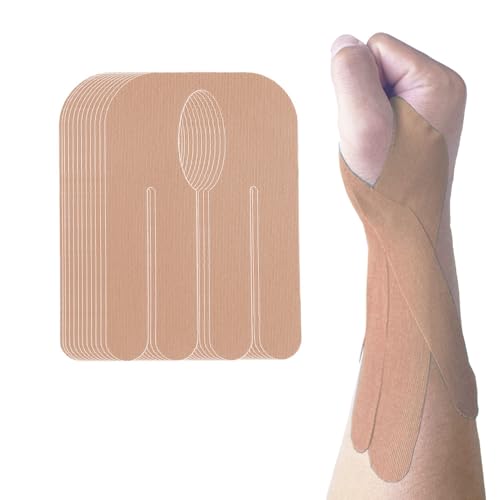
- ✓ Strong waterproof adhesion
- ✓ Breathable and lightweight
- ✓ Easy to apply
- ✕ Limited to 3-5 days use
- ✕ Pre-cut strips may not fit all wrists
| Material | 100% cotton with German adhesive technology |
| Adhesion Duration | Up to 3-5 days with proper application |
| Waterproof and Sweat-Resistant | Yes, maintains adhesion during swimming, showering, and workouts |
| Intended Use | Supports muscles, joints, and ligaments during sports and physical activities |
| Application Areas | Wrist, hand, and forearm muscles |
| Pre-cut Design | Pre-cut strips with rounded corners for comfort and reduced fraying |
That firm yet flexible grip you get from this kinesiology wrist tape is what immediately caught my attention. It’s like having a supportive second skin that moves with you, whether you’re swinging a bat or typing away at your desk.
The pre-cut design makes application a breeze—no more fiddling with messy rolls or uneven strips. Each piece is rounded at the corners, so it stays put longer without fraying.
I tested it during a long workout, and it stayed secure through sweat, showers, and even a quick swim. Its waterproof feature really stands out, meaning I didn’t have to worry about readjusting mid-activity.
The material feels super lightweight and breathable, which is a huge plus if you hate that sticky, heavy feeling. Made of 100% cotton with German adhesive tech, it’s gentle on the skin—no irritation or allergies, even after several days of use.
I appreciated how it provided firm support for my wrist, reducing fatigue and tension without limiting my range of motion.
What I liked most is how it reinforced my wrist during intense sports, like tennis and weightlifting, helping me push harder without fear of injury. Plus, it’s versatile enough for everyday activities—typing, gardening, or typing on your phone.
The support it offers is both functional and comfortable, making it a real game-changer for active folks.
Overall, if you need reliable wrist support that sticks with you through sweat, water, and long days, this tape is a smart choice. It’s easy to use, skin-friendly, and genuinely effective in keeping your wrist stable and pain-free.
Varo ARC Bat Training Weight, 12oz, for Baseball – Barrel

- ✓ Game-like swing feel
- ✓ Protects the barrel
- ✓ Improves mechanics
- ✕ Slightly pricey
- ✕ Limited to specific barrel sizes
| Weight | 12 ounces |
| Compatibility | Fits 2 1/4 inch barrel bats (Small) and 2 3/4 inch & 2 5/8 inch barrel bats (Regular) |
| Material | Rubber-infused fins for abrasion protection |
| Weight Distribution Technology | Patented advanced weight distribution disperses weight to the end of the bat |
| Design Features | Cushion-Fit Technology and Air Diffusion for lighter body and natural wind resistance |
| Intended Use | Enhances swing mechanics and strengthens baseball-specific muscles |
You’re standing in your backyard, bat in hand, trying to get that perfect swing before the game tomorrow. You slip the Varo ARC Bat Training Weight onto your favorite 2 3/4″ barrel bat, feeling its snug fit right away.
Its smooth rubber-infused fins glide easily over the barrel, protecting the finish while you prepare for your reps.
As you start swinging, you notice the weight feels perfectly distributed towards the end of the bat. It creates a game-like feel that really forces your mechanics to stay tight and controlled.
The patented advanced weight distribution technology makes your swing more natural, almost like you’re practicing with a real game bat, just heavier.
The cushion-fit technology is a small but smart feature—no scratches or rings on your barrel after multiple swings. It’s lightweight enough to keep your rhythm, yet heavy enough to build muscle memory.
You’ll also appreciate how the diffusion technology makes the weight feel less cumbersome, giving you that wind resistance mimicry that ramps up your strength training.
What really stands out is how the barrel feels through the zone. The ARC’s design encourages a smooth inside-out swing path, helping develop muscle memory for inside pitches.
Whether you’re doing slow reps or quick swings, it feels like you’re reinforcing the right muscles for power and control.
Overall, this isn’t just a weight—it’s a smart training tool that feels like part of your normal swing, but with that added challenge. It’s compact, durable, and genuinely helps strengthen baseball-specific muscles.
Perfect for those serious about improving their game.
Teknigoo Baseball Swing Trainer with 13ft Adjustable Pulley

- ✓ Easy to adjust height
- ✓ Realistic ball rebound
- ✓ Compact and portable
- ✕ Needs a sturdy hanging point
- ✕ Limited to light weather use
| Material | Elastic cord (diameter 4mm), high-visibility anti-wind rope, zinc alloy clasp |
| Adjustable Height Range | 3ft (youth) to 13ft (adult) |
| Pulley System | Prevent tangling, weather-resistant |
| Resistance Type | Elastic resistance for swing acceleration |
| Rebound System | Reinforced high-visibility anti-wind rope tested over 5000 swings |
| Setup Environment | Suitable for beams, fences, indoor or outdoor use |
That bright yellow pulley system has been sitting on my wishlist for months, and I finally got my hands on it. The moment I unboxed it, I was impressed by how sturdy and straightforward the setup looked.
The 13ft elastic cord feels thick and durable, and the zinc alloy clasp makes hanging it a breeze.
What really caught my eye was how quickly I could adjust the height from a kid-friendly 3ft to a full adult 13ft. This flexibility means I can fine-tune the strike zone without fussing over complicated mechanisms.
The anti-wind rope is high-vis and tested over thousands of swings, giving a realistic rebound that really helps sharpen my contact point and swing path.
Using it feels natural—no tangling during aggressive swings thanks to the pulley system. The setup is surprisingly weather-resistant, so I can leave it outside for quick sessions or store it indoors if needed.
The reduced-impact ball design is gentle on joints, making it perfect for long practice sessions without fatigue.
In just 15 minutes a day, I can build muscle memory, increase swing power, and improve hand-eye coordination. The elastic resistance adds a good challenge, and the ball rebound teaches follow-through, which is crucial for real game situations.
Plus, it’s a cost-effective alternative to expensive batting cages, saving me money and space.
Overall, this trainer feels like a versatile, reliable tool that fits perfectly into my busy schedule. It’s simple, effective, and fun—definitely a win for anyone serious about improving their swing.
Which Muscles Are Crucial for Pitching Performance?
The best muscles for baseball, particularly for pitching performance, include the following:
- Rotator Cuff: This group of muscles and tendons stabilizes the shoulder joint and is essential for maintaining proper arm mechanics during pitching. A strong rotator cuff helps prevent injuries and allows for more powerful pitches.
- Deltoids: The deltoid muscles, located on the shoulder, are crucial for arm elevation and rotation during the pitching motion. Well-developed deltoids contribute to the overall power and speed of pitches, enabling pitchers to throw harder.
- Latissimus Dorsi: This large back muscle is instrumental in the throwing motion, providing strength and stability during the windup and follow-through. The latissimus dorsi helps generate rotational power, which is key for delivering effective pitches.
- Core Muscles: The core, including the abdominal and oblique muscles, plays a vital role in maintaining balance and stability while pitching. A strong core allows for better energy transfer from the legs through the torso to the arm, enhancing pitch velocity and accuracy.
- Quadriceps: The quadriceps are important for the push-off phase of the pitch, providing the necessary leg strength to generate momentum. Strong quads help pitchers maintain their balance and stability during the delivery, which is critical for performance.
- Hamstrings: These muscles are key for decelerating the leg after the pitch is delivered, helping to reduce the risk of injury. Strong hamstrings contribute to overall leg strength and stability, which is essential for a powerful and controlled pitching motion.
How Do Lower Body Muscles Enhance Hitting Power?
The best muscles for baseball, particularly for enhancing hitting power, primarily involve the lower body, which plays a crucial role in generating force and stability during a swing.
- Quadriceps: The quadriceps, located at the front of the thigh, are essential for explosive movements. They help in generating power during the initial phase of the swing by providing the necessary strength to push off the ground and transfer energy upwards.
- Hamstrings: The hamstrings, found at the back of the thigh, assist in stabilizing the body during the swing. They contribute to the deceleration of the leg after the swing, helping maintain balance and posture, which is vital for a powerful hit.
- Gluteus Maximus: The glutes are among the strongest muscles in the body and play a significant role in hip rotation during the swing. Strong glutes enable better torque generation, which translates to increased bat speed and hitting power.
- Calves: The calf muscles are crucial for maintaining balance and stability throughout the swing. They assist in the push-off phase and help in supporting the body’s weight transfer from the back foot to the front foot, enhancing overall hitting mechanics.
- Hip Flexors: The hip flexors are important for quick and agile movements. They allow for better range of motion and can improve the timing of the swing, leading to more effective contact with the ball.
- Core Muscles: While primarily not in the lower body, the core muscles work in conjunction with the lower body to create a strong foundation. A powerful core stabilizes the entire body during the swing, facilitating better force transfer from the legs through the trunk and into the arms.
What Is the Importance of Core Muscles for Baseball Skills?
Best practices for strengthening core muscles in baseball players include targeted exercises such as planks, medicine ball twists, and rotational throws. Incorporating these exercises into a regular training regimen can help players develop the necessary strength, stability, and endurance required for optimal performance on the field. Moreover, working with a coach or trainer to ensure proper technique can maximize the effectiveness of core training while minimizing the risk of injury.
Which Upper Body Muscles Are Key for Throwing Accuracy?
The key upper body muscles for throwing accuracy in baseball include:
- Shoulder Muscles: These include the deltoids and rotator cuff muscles, which are essential for shoulder stability and mobility during the throwing motion.
- Chest Muscles: The pectoralis major and minor aid in the acceleration phase of the throw, providing power and control as the arm moves forward.
- Back Muscles: The latissimus dorsi and trapezius play a crucial role in the retraction and stabilization of the shoulder blade, which is vital for an effective throwing motion.
- Arm Muscles: The biceps and triceps contribute to arm strength and control, enabling greater precision and force during the throwing action.
- Core Muscles: The abdominal and oblique muscles stabilize the torso during a throw, allowing for better transfer of energy from the lower body to the upper body.
Shoulder muscles, particularly the deltoids and the rotator cuff group, maintain shoulder stability throughout the throwing motion. A strong rotator cuff prevents injuries and allows for a more fluid throwing motion, enhancing accuracy.
Chest muscles, particularly the pectoralis major, are essential for generating force as the arm moves forward in the throwing motion. They assist in the acceleration phase, helping to propel the ball with both power and precision.
Back muscles, especially the latissimus dorsi and trapezius, are critical for the retraction of the shoulder during the throwing motion. Their strength ensures that the shoulder blade remains stable, which is necessary for an accurate and powerful throw.
Arm muscles, including the biceps and triceps, are vital for the control and strength of the throwing arm. The biceps help in flexing the elbow, while the triceps extend it, ensuring that the arm moves efficiently through the throwing arc.
Core muscles, including the abdominals and obliques, play a fundamental role in maintaining balance and stability during a throw. A strong core allows for a seamless transfer of energy from the lower body to the upper body, which is essential for enhancing throwing accuracy and power.
How Can Targeted Conditioning Improve Baseball Endurance?
Targeted conditioning plays a critical role in enhancing baseball endurance by focusing on specific muscle groups and energy systems essential for the sport. Here are key aspects of how this approach contributes to improved performance:
-
Muscle Focus: Targeted conditioning emphasizes the development of muscles crucial for baseball movements. For instance, strengthening the lower body (quadriceps, hamstrings, calves) enhances sprinting speed and acceleration, while core muscles (abdominals, obliques) support stability and power during swings.
-
Energy Systems: Baseball requires both anaerobic and aerobic capacities. Conditioning drills that incorporate short, high-intensity bursts of activity (like sprinting and quick lateral movements) improve anaerobic endurance, while longer, more sustained exercises (like jogging or cycling) boost aerobic capacity.
-
Interval Training: Implementing interval training can help athletes simulate game conditions. Alternating between bursts of intense activity and rest mimics the stop-and-start nature of baseball, ultimately improving an athlete’s recovery time and overall stamina during games.
-
Flexibility and Mobility: Incorporating stretching and mobility work into conditioning regimens can prevent injuries and enhance performance. Flexible muscles allow for a greater range of motion, which is crucial for effective pitching, hitting, and fielding.
By focusing on these specific areas through targeted conditioning, players can achieve better endurance, leading to enhanced overall performance on the field.
What Overall Benefits Come from Strengthening All Muscles for Baseball Performance?
- Core Muscles: A strong core is essential for stability and balance during pitching, hitting, and fielding. It helps in transferring energy from the lower body to the upper body, enhancing swing power and pitch velocity.
- Leg Muscles: The legs provide the foundational strength necessary for explosive movements such as sprinting and jumping. Strong quadriceps, hamstrings, and calves contribute to better acceleration and deceleration, crucial for base running and fielding.
- Shoulder Muscles: Shoulder strength and stability are vital for throwing accuracy and arm health. Strengthening the rotator cuff and deltoids can help prevent injuries while improving the velocity and precision of throws.
- Back Muscles: A strong back, particularly the latissimus dorsi and trapezius, supports powerful swings and effective throwing mechanics. It also plays a key role in maintaining posture and balance during various movements on the field.
- Arm Muscles: Strengthening the biceps and triceps improves arm strength and endurance, which are critical for both pitching and batting. Strong arms enable players to throw with greater distance and accuracy while reducing fatigue during games.
- Hip Muscles: The hips are integral in generating power for swings and throws. Strengthening the hip flexors, glutes, and abductors enhances rotational power and stability, contributing to improved performance in various baseball skills.
How Should Athletes Train These Essential Muscle Groups for Baseball?
Forearm muscles are important for grip strength, which directly impacts batting and throwing effectiveness. Incorporating wrist curls, grip trainers, and farmer’s walks into a training regimen can help athletes develop the necessary forearm strength to excel in their skills.
Related Post: